



|
Rev. Fr.
Leonard Goffine's INSTRUCTION
ON THE FIRST SUNDAY AFTER EASTER,
Why is this Sunday called Dominica in Albis or White Sunday? Because on this day the neophytes laid aside the white dress which, as emblem of their innocence, they received on Holy Saturday, and put on their necks an Agnus Dei, made of white wax, and blessed by the pope, to remind them always of the innocence for which they were given, and of the meekness of the Lamb Jesus. For which reason the Church sings at the Introit: INTROIT As newborn babes, alleluia: desire the rational milk without guile. Alleluia, alleluia, alleluia. (I Pet II. 2.) Rejoice to God our helper: sing aloud to the God of Jacob. (Ps. LXXX.) Glory, &c. COLLECT Grant, we beseech Thee, Almighty God, that we, who have completed the paschal solemnities may, through Thy merciful bounty, ever retain them in our life and conversation. Through. EPISTLE (I John V. 4-100.) Dearly Beloved, Whatsoever is born of God overcometh the world; and this is the victory which overcometh the world, our faith. Who is he that overcometh the world, but he that believeth that Jesus is the Son of God? This is he that came by water and blood, Jesus Christ: not by water only, but by water and blood. And it is the spirit which testifieth that Christ is the truth. And there are three who give testimony in heaven: the Father, the Word, and the Holy Ghost: and these three are one. And there are three that give testimony on earth: the spirit, and the water, and the blood: and these three are one. If we receive the testimony of men, the testimony of God is greater: for this is the testimony of God, which is greater, because he hath testified of his Son. He that believeth in the Son of God, hath the testimony of God in himself. INSTRUCTION As in his gospel, so in his epistles, and especially in this, St. John proves the divinity of Christ which had been denied by some heretics. He says that Christ had come to purify all men from sin by water and blood, that is, by His blood shed on the cross for our reconciliation, and by the water of baptism to which He has given the power, the divine effect of His blood, and has thus proved Himself the divine Redeemer. This His divine dignity is attested by the Holy Ghost who lived in Christ and worked through Him with His fulness, and when sent by Him after our Lord's Ascension, produced most wonderful effect in the apostles and the faithful. As now on earth three, the Spirit, water, and blood, give testimony of Christ's divinity and agree in it, so also in heaven three, the Father, who calls Him His beloved Son, (Matt, III. 17.) the Word, or the Son Himself, who wrought so many miracles, the Holy Ghost, when He descended upon Him at the baptism in the Jordan, (Luke III. 22.) give testimony of His divinity, and these also agree with one another in their testimony. If Christ is truly God, then we must believe in Him, and this faith must be a living one, that is, it must prove fertile in good works, and this faith conquers the world by teaching us to love God above all, to despise the world with its pleasures, and to overcome it by indifference. Let us strive to have such faith, and we shall overcome all temptations and gain the eternal crown. ASPIRATION O Lord Jesus! strengthen me by a lively faith in Thy divinity, so that I may not succumb in the spiritual combat against the world, the flesh, and the devil, and be eternally lost.
* What follows is omitted on the Feast of St. Thomas, 21st of December. Why does Christ so often wish peace to the apostles? To show that He only, by His death and resurrection, has made peace between God and man, and that His followers should be known by their harmony. (John XIII. 35.) There is a threefold peace: peace with God, by avoiding sin; peace with ourselves, that is, a good conscience; peace with our neighbor, by the exercise of charity. This threefold peace is necessary for our salvation. Why did Jesus breathe upon the apostles when giving them the power to forgive sin? To show that as bodily life was once given to Adam by the breath of God, so should the spiritual life be given henceforth by the apostles and their successors, through the Holy Ghost in the Sacrament of Penance, to the children of Adam who were spiritually dead. Why did God permit Thomas to doubt the Resurrection of Christ? That Thomas, as well as we, says St. Gregory, should be strengthened in humble belief in the Resurrection of Christ, and that all doubts should be removed. Had Thomas true faith when with his own eyes he saw Christ? Yes, for he saw Christ only in His humanity, and yet testified to His divinity by exclaiming: My Lord and my God! Is it true, meritorious faith not to be ready to believe before seeing that which is to be believed? By no means; for faith consists precisely in firmly holding as true that which is not seen. Therefore Christ calls him blessed who has not seen and yet believes. When is faith true and meritorious? That is true faith which firmly believes all that God has revealed, whether written or unwritten, and when one lives in accordance with that faith; for faith in Jesus simply does not save us, when that which He has commanded is not performed. (Matt VII, 21.; James II. 20.) That faith is meritorious which without doubting and without hesitation willingly submits the understanding to revealed truths which it cannot comprehend, and this for the love of Gods who is eternal truth and cannot deceive. Whence do we know for certain that God has revealed certain things? From the Church of Christ which alone preserves the revealed word of God faithfully and uncorrupted, as it is contained in the Bible and in tradition; by the Holy Ghost all truth is given to the Church, and Christ remains with her until the end of the world. (Matt. XXVIII. 20.) Has the Church of Christ any marks by which it may be known? Christ's Church has these four marks: it is One, it is Holy, it is Catholic, and it is Apostolic. How is the, Church one? The Church is one, because all its members agreein one faith, are all in one communion, and are all under one head. (Matt. XVI, 18.; Eph. IV. 37.) How is the Church Holy? The Church is Holy, in her Founder, Jesus Christ, and by teaching a holy doctrine, by inviting all to a holy life, and by the eminent holiness of so many thousands of her children. How is the Church Catholic? The Church is Catholic or Universal, because she subsists in all ages, teaches all nations, (Matt. XXVII. 19, 20.) and maintains all truth. How is the Church Apostolic? The Church is Apostolic, because she comes down by a perpetual succession from the apostles of Christ, and has her doctrines her orders, and her mission from them. Which is this true Church? The Roman Catholic Church, for she alone has these marks. She is One in her head, the Pope of Rome, in her doctrine, and in her Sacraments, which is evident since she excludes all those who do not accept all her dogmas. She is Holy, for Christ her Founder is holy; and her doctrine and Sacraments lead to holiness, as shown by the multitude of her saints whose sanctity God arms by great miracles. No sect has saints. She is Catholic or Universal, for she has been in existence always from the times of the apostles, as is clearly shown by the fact that from the times of the apostles there have always been some who separated from her and founded sects. The Catholic Church has always existed, and cannot perish or become corrupt, since Christ has promised to remain with her to the end of the world; she is also spread over the whole world, is always being announced to all nations, and is fitted for all generations and for all people. She is Apostolic, for she accepts no doctrine which does not come from the apostles, and she can prove that the ministers of the Church, the bishops, have come down in unbroken succession from the apostles. Can those who remain outside the Catholic Church be, saved? The Council of Trent (Sess. V. in the Introduction) assigns the Catholic faith as the one without which it is impossible to please God, and the Roman Catechism teaches: (I part. art. 9.) "The Church is also called Catholic or Universal, because all who desire eternal salvation must cling to, and embrace her, like those who entered the ark to escape perishing in the flood." According to this doctrine of the Church, which the holy Fathers affirm, only those idolaters and obstinate heretics are excluded from salvation who knowingly deny the truth, and will not enter the Church. The Catholic Church does not condemn the unbelievers, she prays for them, leaves judgment to the Lord, who alone knows the heart, and knows whether the error is culpable or not, and she calls on all her members to pray for their enlightenment. Are we then already saved, if we belong to the true Church? No, we must also live up to the faith which she teaches make good use of all means of salvation, regard and honor all her regulations and commands, for otherwise the words of Christ will be verified in us: And I say to you that many shall come from the east and the west, and shall sit down with Abraham, and Isaac, and Jacob, in the kingdom of heaven: but the children of the kingdom (the true Church) shall be cast out into exterior darkness. (Matt. VIII. 11.) |
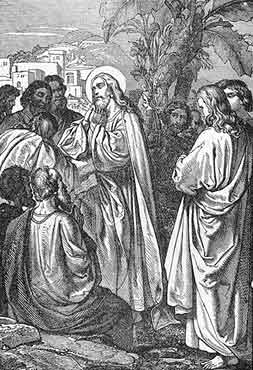 GOSPEL
(John XX. 1931.) At that time, When it
was late that same day, the first of the
week and the doors were shut,where the
disciples were gathered together, for
fear of the Jews, Jesus came, and stood
in the midst, and said to them: Peace
be to you. And when he had said this,
he showed them his hands and his side.
The disciples therefore were glad when,
they saw the Lord. He said therefore to
them again: Peace be to you. As the Father
hath sent me, I also send you. When he
had said this, he breathed on them; and
he said to them: Receive ye the Holy Ghost;
whose sins you shall forgive, they are
forgiven them: and whose sins you shall
retain, they are retained. Now Thomas,
one of the twelve, who is called Didymus,
was not with them when Jesus came. The
other disciples therefore said to him:
We have seen the Lord. But he said to
them: Except I shall see in his hands
the print of the nails, and put my finger
into the place of the nails, and put my
hand into his side, I will not believe.
And after eight days, again his disciples
were within, and Thomas with them. Jesus
cometh, the doors being shut, and stood
in the midst, and said: Peace be to you.
Then he said to Thomas: Put in thy finger
hither, and see my hands, and bring hither
thy hand, and put it into my side; and
be not faithless, but believing. Thomas
answered and said to him: My Lord and
my God. Jesus saith to him: Because thou
hast seen me, Thomas, thou hast believed:
blessed are they that have not seen, and
have believed.*
Many other signs also did Jesus in the
sight of his disciples, which are not
written in this book. But these are written,
that you may believe that Jesus is the
Christ, the Son of God; and that, believing,
you may have life in his name.
GOSPEL
(John XX. 1931.) At that time, When it
was late that same day, the first of the
week and the doors were shut,where the
disciples were gathered together, for
fear of the Jews, Jesus came, and stood
in the midst, and said to them: Peace
be to you. And when he had said this,
he showed them his hands and his side.
The disciples therefore were glad when,
they saw the Lord. He said therefore to
them again: Peace be to you. As the Father
hath sent me, I also send you. When he
had said this, he breathed on them; and
he said to them: Receive ye the Holy Ghost;
whose sins you shall forgive, they are
forgiven them: and whose sins you shall
retain, they are retained. Now Thomas,
one of the twelve, who is called Didymus,
was not with them when Jesus came. The
other disciples therefore said to him:
We have seen the Lord. But he said to
them: Except I shall see in his hands
the print of the nails, and put my finger
into the place of the nails, and put my
hand into his side, I will not believe.
And after eight days, again his disciples
were within, and Thomas with them. Jesus
cometh, the doors being shut, and stood
in the midst, and said: Peace be to you.
Then he said to Thomas: Put in thy finger
hither, and see my hands, and bring hither
thy hand, and put it into my side; and
be not faithless, but believing. Thomas
answered and said to him: My Lord and
my God. Jesus saith to him: Because thou
hast seen me, Thomas, thou hast believed:
blessed are they that have not seen, and
have believed.*
Many other signs also did Jesus in the
sight of his disciples, which are not
written in this book. But these are written,
that you may believe that Jesus is the
Christ, the Son of God; and that, believing,
you may have life in his name.