|
Rev.
Fr. Leonard Goffine's
The Church's
Year
INSTRUCTION
ON GOOD FRIDAY
This
day was formerly for the Jewish people
a day of preparation for Easter, and was
called by them the Parasceve; for us Christians
it is the anniversary of the death and
burial of our Lord who on this day, being
Himself both High-Priest and Victim, offered
Himself upon the cross for the salvation
of the world.
Why
do Catholics hold this day in such veneration?
Because
it is one of the greatest days from the
beginning of the world to its end. On
this day the designs which God had from
all eternity were perfected, as Jesus
Himself expressed when He said, All is
consummated; for on this day He was given
up to the Gentiles by the Jews, was scourged,
crowned with thorns, loaded with the cross,
dragged to Calvary amid taunts and sneers,
there nailed to the cross between two
thieves, and by His painful death finished
the great work of redemption.
Why
did Christ suffer so much to redeem, us?
To
show us what an immense evil sin is, on
account of which He underwent such cruel
sufferings that He might satisfy divine
justice. His love for us was so great
that He gave the last drop of His blood
to save us. He rendered satisfaction for
all men without exception, that none might
be lost, that every one might possess
eternal life. Look up today, and every
day of thy life, to Christ on the cross,
and see how God punishes sin, since He
did not even spare His only-begotten Son,
who took upon Himself our sins, and for
them died this cruel death. What death
is due to thee, if thou dost not despise
and flee from sin?
Why
does the Church celebrate the commemoration
of the passion of Christ in such solemn
quietness?
That
we may be induced to thank the Saviour
for our redemption, and to move us to
sincere love for Him by serious meditation
on His passion. For this reason St. Paul
ordered the observance of this day, and
the Christians even in his time sanctified
it by deep mourning, and rigorous fasting.
Why
do we not observe Good Friday with such
festivities as do the Protestants? [in
Europe.]
Because
our grief for our Saviour's death is too
great to permit us to celebrate it joyously,
even nature mourned His death; the sun
was darkened, the earth trembled and the
rocks were rent. Although the Christian
rejoices on this day in the grace of redemption
through Christ, he is aware that his joy
cannot be pleasing to God unless he endeavors
to participate in the merits of the passion
and death of Christ by sorrow for his
sins, by amendment and penance; and this
is the very reason why the Church solemnizes
this day in a sad and touching manner.
Why
are there no candles lighted at the beginning
of the service?
To
signify that on this day Christ, the Light
of the world, became, as it were, extinguished.
Why
does the priest prostrate himself before
the altar at the beginning of the service?
That
with him we should consider in deepest
sorrow and humility how the Saviour died
on the cross for our sins, and how unworthy
we are on account of them to lift up our
faces.
Why
does the service commence with the reading
of two lessons?
Because
Christ died for Jews and Gentiles. The
first lesson is from the Prophet Osee,
(Osee VI, 1-6.) and the other from Exodus,
(Exod. XII. 1-11.) from them we infer
that by the bloody death of the immaculate
Lamb Jesus we are healed of our sins,
and redeemed from death.
After
the first lesson the Priest says the following:
COLLECT
O God! from whom Judas received
the punishment of his sin, and the thief
the reward of his confession: grant us
the effects of Thy mercy; that as our
Lord Jesus Christ at the time of His passion
bestowed on each a different recompense
of his merits, so having destroyed the
old man in us, He may give us the grace
of His Resurrection. Who liveth, &
c.
REMARK
After the Passion the priest prays in
behalf of the one, only true Church, that
she may increase, and that peace and unity
may always remain with her; for the pope,
that his government may be blessed; for
the bishops, priests, the clergy, and
the people, that they may serve God in
justice; for those converted to the faith,
that they may continue to grow an knowledge
and a zeal for the holy religion; for
rulers as defenders of the Church, that
they may govern with wisdom and
justice, and that those under them may
be loyal to them with fidelity and obedience;
for the unfortunate, that God may have
mercy on them; for heretics and apostates,
that they may be brought back from error
to the truth of the Catholic faith; for
the Jews, that they may be enlightened;
for the heathens, that they may be converted.
Before each prayer the priest says Oremus,
Let us pray Flectamus genua,
(Let us kneel) when kneeling, we say Amen,
and at the call Levate (Rise up) we rise:
except at the prayer for the Jews, when
the genuflection is omitted, because the
Jews bent the knee in mockery before our
Lord. As Christ on this day prayed for
all men, the Church desires, that we do
the same; say, therefore, the following:
PRAYER
O Lord Jesus! who on the cross, while
enduring the most excruciating pain, didst
pray with a loud voice for all men, we
humbly pray Thee for Thy vicar, Pope N.,
for our bishop N., for all the priests
and clergy, for our civil government,
for the neophytes, for the unfortunate
and oppressed, for all Catholics, that
Thou mayst preserve them in the true faith,
and strengthen them, that they may serve
Thee according to their different vocations.
We pray Thee also for all unbelievers,
and those separated from the true fold,
for the Jews, and for the heathens, that
Thou mayst unite all in Thy holy Church,
and bring them to eternal salvation. Amen.
What
is done by the priest after these prayers?
The
priest then goes down from the epistle
side of the altar, takes the veiled crucifix,
and extending it towards the people, uncovers
it so much that the head is seen, and
sings in a low voice: Ecce lignum crucis,
&c.: Behold the wood of the cross
on which the Salvation of the world was
hanged! The choir answers: Venite, adoremus:
Come, let us adore! at which all kneel,
adoring Christ who died on the cross for
us. The priest then advances to the corner
of the altar, uncovers the right arm of
the Crucifix, and sings in a higher tone:
Ecce lignum crucis, &c.; to which
the choir responds as before. Then at
the middle of the altar he uncovers the
entire Crucifix, and elevating it, sings
in a still higher tone than before: Ecce
lignum, &c. The choir responds again:
Venite adoremus. The image of the crucified
Redeemer, which has been hidden from our
view since Passion Sunday should make
a deep impression upon us; it teaches
us at the same time how the Saviour became
gradually known to the world. Jesus is
adored three times, because He was mocked
three times: in the court-yard of the
high-priest, in Pilate's house, and on
mount Calvary. When the crucifix is unveiled
the priest carries it to the place prepared
for it, and kneeling he places it on the
cushion covered with a white veil to represent
the laying of Christ in the sepulchre;
he then retires to the gospel side of
the Altar where he puts off his shoes,
like Moses, when he was about to approach
Almighty God; he then kneels and meditates
on the passion of Christ; goes a few steps
forward, again kneels, and still a third
time, this time directly in front of the
crucifix. He adores Jesus with humility,
considers His infinite love, which brought
Him to the cross and laid Him in the sepulchre
for our Redemption; and then kisses with
reverence the image of the crucified Saviour.
During this veneration of the cross the
choir chants alternately the versicles
called the Reproaches, and between each
part of the canticle the following words
in Greek and Latin: "Holy God! Holy
and strong God! Holy and immortal God!
have mercy on us!" In these versicles
Christ tenderly and lovingly reproaches
the people who crucified Him, which we
may also take to ourselves, who have so
often crucified Jesus anew by sin. They
are therefore called reproaches, words
of complaint, and continue during the
veneration of the cross by the priest.
Afterwards a hymn of praise composed by
St. Fortunatus is sung in honor of the
victory gained on the cross by our Saviour,
which calls upon us also to render praise
and thanks to Jesus crucified.
Adore
also in deepest humility the Saviour who
died on the cross, and is now victoriously
enthroned; ask with sincere contrition
the forgiveness of your sins, and by a
threefold advance, kiss with sincere love
His sacred wounds, promising to love all
men, even your enemies, and to have pity
on all in distress, according to His example.
What
follows the veneration of the cross?
The
sacred Host consecrated on Holy Thursday,
and kept in the chalice, is brought by
the priest in procession, from the
repository to the high altar, incensed
in sign of adoration, and after a few
short prayers the priest elevates It with
the right hand, breaks It, puts one part
in the chalice and communicates, and soon
after leaves the altar.
Is
there, then, no Mass said on this day?
No;
for on this day there is no bread and
wine consecrated, which is the essential
part of the Sacrifice of the Mass.
Why
is no Mass said on this day?
Because
Jesus Christ having this day sacrificed
Himself on the altar of the cross in a
bloody offering, it is not meet that His
death sacrifice should be today repeated
even in an unbloody manner. Besides this,
Mass is a joyous and comforting sacrifice,
and is therefore omitted because of our
mourning.
What
devotions may be practised to-day?
Besides
adoring Jesus in the holy sepulchre, the
stations may be said, meditations made
on the sufferings of our Lord. Let the
words of St. Augustine touch your heart,
when he places the crucified Redeemer
before our mind in the following words:
"Behold the wounds of Jesus who is
hanging on the cross, the blood of the
dying, the price of our redemption! His
head is bowed to give the kiss of peace;
His side is open to love; His arms are
extended to embrace us; His whole body
sacrificed for our redemption. Let these
words be the subject of your meditation
that He may be wholly in your heart who
is nailed to the cross for you."
MANNER
OF CONTEMPLATING CHRIST'S BITTER PASSION
Christ
also suffered for us: leaving you an example
that you should follow his steps. (I Peter
II. 21.)
Whence
does it come," writes St. Alphonsus
Ligouri, "that so many of the faithful
look with so much indifference at Christ
on the cross? They generally assist during
Holy Week at the commemoration of His
death without any feeling of gratitude
or compassion, as if it were a fable or
an event in which they had no interest.
Know they not, or believe they not what
the gospel relates of Christ's passion?
Indeed they know it, and believe it, but
do not think of it. It is impossible that
he who believes and meditates, should
fail to become burning with love for God
who suffers and dies for love of him."
But why, we may ask here, are there so
many who draw so little benefit even from
the contemplation of the passion and death
of Jesus? Because they fail to consider
and imitate the example which Christ gives
in His sufferings.
"The
cross of Christ," says St. Augustine,
"is not only a bed of death, but
a pulpit of instruction." It is not
only a bed upon which Christ dies, but
the pulpit from which He teaches us what
we must do. It should now be our special
aim to meditate upon the passion of Christ,
and to imitate those virtues which shone
forth so preeminently in His passion and
death. But many neglect to do this: They
usually content themselves with compassion
when they see Christ enduring such great
pains, but they see not with what love,
humility, and meekness He bears them;
and so do not endeavor to imitate His
example. That you, O Christian soul, may
avoid this mistake, and that you may draw
the greatest possible benefit for your
soul, from the contemplation of the passion,
and death of Christ, attend to that which
is said of it by that pious servant of
God, Alphonse Rodriguez:
We
must endeavor to derive from the meditation
on the mysteries of the passion and death
of Christ this effect, that we may imitate
His virtues, and this by slowly and attentively
considering each virtue by itself, exercising
ourselves in forming a very great desire
for it in our hearts, making a firm resolution
to practice it in words and works, and
also to conceive a holy aversion and horror
of the opposite vice; for instance, when
contemplating Christ's condemnation to
the death of the cross by Pilate, consider
the humility of Jesus Christ, who being
God, as humble as He was innocent, voluntarily
submitted and silently accepted the unjust
sentence and the ignominious death. Here
you see from the example given by Jesus,
how you should despise yourself, patiently
bear all evil, unjust judgment; and detraction,
and even seek them with joy as giving
you occasion to resemble Him. To produce
these necessary effects and resolutions,
you should at each mystery contemplate
the following particulars:
First,
Who is it that suffers? The most innocent,
the holiest, the most loving; the only-begotten
Son of the Almighty Father, the Lord of
heaven and earth. Secondly; What pains
and torments, exterior and interior, does
He suffer? Thirdly, In what manner does
He suffer, with what patience, humility,
meekness and love, does He bear all ignominy
and outrage? Fourthly, For whom does He
suffer? For all men, for His enemies and
His executioners. Fifthly, By whom does
He suffer? By Jews and heathens, by soldiers
and tyrants, by the devil and all impious
children of the world to the end of time,
and all who were then united in spirit
with His enemies. Sixthly, Why does He
suffer? To make reparation for all the
sins of the whole world, to satisfy the
justice of God, to reconcile the Heavenly
Father, to open heaven, to give us His
infinite merits that we may from them
have strength to follow the way to heaven.
At the consideration of each of these
points, and indeed at each mystery of
the passion of Christ, the imitation of
the example of His virtues is the main
object, because the true life of the Christian
consists in the imitation of Jesus. In
considering each stage of the passion
of Christ place vividly before your mind
the virtue which He practiced therein;
contemplate it and ask yourself whether
you possess this virtue, or whether you
still cherish the opposite vice. If you
find the latter to be the case make an
act of contrition, with the firm resolution
to extirpate this vice, and excite in
yourself a sincere desire for the opposite
virtue. In this way you will draw the
greatest advantage from the contemplation
of Christ's passion, and will resemble
Christ, and, as the pious Louis of Granada
says, there can be no greater honor and
adornment for a Christian than to resemble
his divine Master, not in the way that
Lucifer desired, but in that which He
pointed out, when He said: "I have
given you an example, that as I have done
to you, so do you also."
THE
PASSION OF OUR LORD JESUS CHRIST
ACCORDING TO ST. JOHN. (CHAPS. XVIII.,
XIX.)
At
that time, Jesus went forth with his disciples,
over the brook of Cedron, where there
was a garden into which he and his disciples
entered. Now Judas also, who betrayed
him, knew the place: because Jesus had
often resorted thither together with his
disciples. Judas therefore having received
a band of men and servants from the chief
priests and the Pharisees, cometh thither
with lanterns and torches and weapons. Jesus,
therefore, knowing all things that should
come upon him, went forth and said to
them: Whom seek ye? They answered him:
Jesus of Nazareth. Jesus saith to them:
I am he. And Judas also, who betrayed
him, stood with them. As soon then as
he had said to them: I am he; they went
backward, and fell to the ground.
Again
therefore he asked them: Whom seek ye?
And they said: Jesus of Nazareth. Jesus
answered: I have told you, that I am he.
If therefore you seek me, let these go
away. That the word might be fulfilled
which he had said: Of them whom thou hast
given me, I have not lost any one. Then
Simon Peter having a sword, drew it, and
struck the servant of the high-priest,
and cut off his right ear. And the name
of the servant was Malchus. Then Jesus
said to Peter: Put up thy sword into the
scabbard. The cup which my Father hath
given me, shall not I drink it?
Then
the band, and the tribune, and the servants
of the Jews took Jesus, and bound him:
and they led him away to Annas first:
for he was father-in-law to Caiphas, who
was the high-priest of that year. Now
Caiaphas was he who had given the counsel
to the Jews, that it was expedient that
one man should die for the people.
And
Simon Peter followed Jesus, and so did
another disciple. And that disciple was
known to the high-priest, and went in
with Jesus into the palace of the high-priest.
But Peter stood at the door without. Then
the other disciple who was known to the
high-priest, went out, and spoke to her
that kept the door: and brought in Peter.
And the maid that waited at the door,
saith to Peter: Art not thou also one
of this man's disciples? He saith : I
am not.
Now
the servants and officers stood at a fire
of coals, because it was cold, and warmed
themselves: and with them was Peter also
standing, and warming himself.
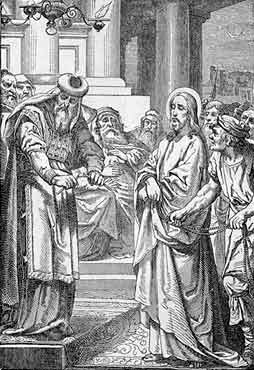 The
high-priest then asked Jesus of his disciples,
and of his doctrine. Jesus answered him:
I have spoken openly to the world: I have
always taught in the synagogue, and in
the temple, whither all the Jews resort:
and in secret I have spoken nothing. Why
askest thou me? ask them who have heard
what I have spoken to them: behold they
know what things I have said. And when
he had said these things, one of the officers
standing by, gave Jesus a blow, saying:
Answerest thou the high-priest so? Jesus
answered him: If I have spoken, evil,
give testimony of the evil: but if well,
why strikest thou me? The
high-priest then asked Jesus of his disciples,
and of his doctrine. Jesus answered him:
I have spoken openly to the world: I have
always taught in the synagogue, and in
the temple, whither all the Jews resort:
and in secret I have spoken nothing. Why
askest thou me? ask them who have heard
what I have spoken to them: behold they
know what things I have said. And when
he had said these things, one of the officers
standing by, gave Jesus a blow, saying:
Answerest thou the high-priest so? Jesus
answered him: If I have spoken, evil,
give testimony of the evil: but if well,
why strikest thou me?
And
Annas sent him bound to Caiphas the high-priest.
And
Simon Peter was standing and warming himself.
They said therefore to him: Art not thou
also one of his disciples? He denied it
and said: I am not. One of the servants
of the high-priest, a kinsman to him whose
ear Peter, cut off, saith to him: Did
not I see thee in the garden with him?
Then Peter: again denied, and immediately
the cock crowed. Then they led Jesus from
Caiphas to the governor hall. And it was
morning: and they went not into the hall,
that they might not be defiled, but that
they might eat the passover.
Pilate
therefore went out to there, and said:
What accusation bring you against this
man? They answered and said to him: If
he were not a malefactor, we would not
have delivered him up to thee. Pilate
then said to them: Take him you, and judge
him according to your law. The Jews therefore
said to him: It is not lawful for us to
put any man to death. That the word of
Jesus might be fulfilled which he said,
signifying what death he should die. Pilate
therefore went into the hall again, and
called Jesus, and said to him: Art thou
the king of the Jews? Jesus answered:
Sayest thou this thing of thyself, or
have others told it thee of me. Pilate
answered: Am I a Jew? Thy own nation,
and the chief priests have delivered thee
up to me. What hast thou done? Jesus answered:
My kingdom is not of this world. If my
kingdom were of this world, my servants
would certainly strive that I should not
be delivered to the Jews: but now my kingdom
is not from hence. Pilate therefore said
to him: Art thou a king then? Jesus answered:
Thou sayest that I am a king. For this
was I born, and for this came I into the
world, that I should give testimony to
the truth: every one that is of
the truth, heareth my voice.
Pilate
saith to him: What is truth?
 And
when he had said this, he went out again
to the Jews, and saith to them: I find
no cause in him. But you have a custom
that I should release one unto you at
the passover: will you therefore that
I release unto you the king of the Jews?
Then cried they all again, saying: Not
this man, but Barabbas. Now Barabbas was
a robber. And
when he had said this, he went out again
to the Jews, and saith to them: I find
no cause in him. But you have a custom
that I should release one unto you at
the passover: will you therefore that
I release unto you the king of the Jews?
Then cried they all again, saying: Not
this man, but Barabbas. Now Barabbas was
a robber.
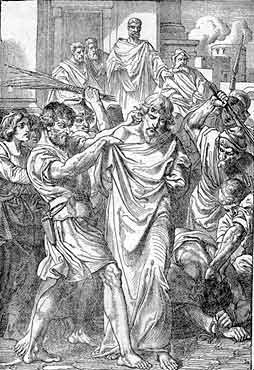
Then,
therefore, Pilate took Jesus, and scourged
him. And the soldiers platting a crown
of thorns, put it upon his head: and they
put on him a purple garment, and they
came to him, and said: Hail, King of the
Jews! And they gave him blows. Pilate,
therefore, went forth again, and saith
to them: Behold I bring him forth to you
that you may know that I find no cause
in him. So Jesus came forth wearing the
crown of thorns, and the purple garment.
And he saith to them: Behold the man.
When the chief priests, therefore, and
the officers had seen him, they cried
out, saying: Crucify him, crucify him.
Pilate saith to them: Take him you, and
crucify him; for I find no cause in him.
The Jews answered him: We have a law;
and according to the law he ought to die,
because he made himself the Son of God.
When Pilate therefore had heard this saying,
he feared the more. And he entered into
the hall again, and he said to Jesus:
Whence art thou? But Jesus gave him no
answer. Pilate therefore said to him:
Speakest thou not to me? knowest thou
not that I have power to crucify thee,
and I have power to release thee? Jesus
answered: Thou shouldst not have any power
against me, unless it were given thee
from above. Therefore he that hath delivered
me to thee, hath the greater sin. And
from thenceforth Pilate sought to release
him. But the Jews cried out, saying: If
thou release this man, thou art not Caesar's
friend. For whosoever maketh himself a
king, speaketh against Caesar.
Now
when Pilate had heard these words, he
brought Jesus forth: and sat down in the
judgment-seat, in the place that is called
the Pavement, and in Hebrew, Gabbatha.
And it was the parasceve of the passover,
about the sixth hour, and he saith to
the Jews: Behold your king. But they cried
out: Away with him, away with him, crucify
him. Pilate saith to them: Shall I crucify
your king? The chief priests answered:
We have no king but Ceasar. Then therefore,
he delivered him to them to be crucified.
And they took Jesus, and led him forth.
And bearing his own cross he went forth
to that place which is called Calvary,
but in Hebrew, Golgotha, where they crucified
him, and with him two others, one on each
side, and Jesus in the midst. And Pilate
wrote a title also, and he put it upon
the cross. And the writing was: Jesus
of Nazareth, the king of the Jews.
The
title, therefore, many of the Jews did
read, because the place where Jesus was
crucified was nigh to the city: and it
was written in Hebrew, in Greek, and in
Latin. Then the chief-priest of the Jews
said to Pilate: Write not, the king of
the Jews: but that he said: I am the king
of the Jews. Pilate answered: What I have
written, I have written. Then the soldiers,
when they had crucified him, took his
garments (and they made four parts, to
every soldier a part) and also his coat.
Now the coat was without seam, woven from
the top throughout.
They
said then one to another: Let us not cut
it, but let us cast lots for it, whose
it shall be: that the Scripture might
be fulfilled which saith: They have parted
my garments among them, and upon my vesture
they have cast lots. And the soldiers
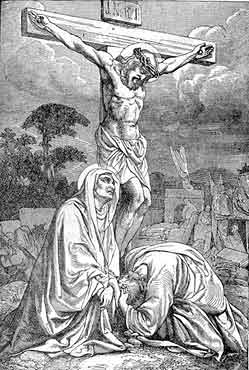
did indeed these things. Now there stood
by the cross of Jesus, his mother, and
his mother's sister, Mary of Cleophas,
and Mary Magdalene.
When
Jesus therefore saw his mother, and the
disciple standing, whom he loved, he saith
to his mother: Woman! behold thy son.
After that, he saith to the disciple:
Behold thy mother. And from that hour
the disciple took her to his own. Afterwards,
Jesus knowing that all things were now
accomplished, that the Scripture might
be fulfilled, said: I thirst. Now there
was a vessel set there full of vinegar.
And they put a sponge full of vinegar,
about hyssop, and put it to his mouth.
When Jesus, therefore, had taken the vinegar,
he said: It is consummated. And bowing
his head, he gave up the ghost.
 Then
the Jews (because it was the parasceve)
that the bodies might not remain upon
the cross on the Sabbath-day(for that
was a great Sabbath-day), besought Pilate
that their legs might be broken, and that
they might be taken away. The soldiers,
therefore, came: and they broke the legs
of the first, and of the other that was
crucified with him. Then
the Jews (because it was the parasceve)
that the bodies might not remain upon
the cross on the Sabbath-day(for that
was a great Sabbath-day), besought Pilate
that their legs might be broken, and that
they might be taken away. The soldiers,
therefore, came: and they broke the legs
of the first, and of the other that was
crucified with him.
But
after they were come to Jesus, when they
saw that he was already dead, they did
not break his legs. But one of the soldiers
opened his side with a spear, and immediately
there came out blood and water. And he
that saw it gave testimony, and his testimony
is true. And he knoweth that he saith
true, that you also may believe.
For
these things were done that the Scripture
might be fulfilled: You shall not break
a bone of him. And again another Scripture
saith: They shall look on him whom they
pierced.
And
after these things, Joseph of Arimathea
(because he was a disciple of Jesus, but
secretly for fear of the Jews), besought
Pilate that he might take away the body
of Jesus. And Pilate gave him leave. He
came therefore and took away the body
of Jesus. And Nicodemus also came, he
who at the first came to Jesus by night,
bringing a mixture of myrrh and aloes;
about a hundred pound weight.
They
took therefore the body of Jesus, and
wrapped it in linen cloths with the spices,
as the manner of the Jews is, to bury.
Now there was a garden in the place where
he was crucified; and in the garden a
new sepulchre, wherein no man yet had
been laid. Therefore, because of the parasceve
of the Jews, they laid Jesus there; for
the sepulchre was nigh at hand.
THE
PEOPLE AT THE CROSS, AND THE PEOPLE OF
TODAY
At
Golgotha, in sight of the temple and city
of Jerusalem, in the presence of two or
three millions of Jews, who had come to
the city from all lands, Jesus, the Son
of God, hung upon the cross, an expiatory
sacrifice for mankind burdened with all
manner of sin. Near cross of her dying
Son stood Mary, His mother, filled with
grief; by her side John, the beloved disciple,
and kneeling at the foot of the cross
almost insensible from sorrow and anguish,
convulsively winding her arms around the
wood of the cross, was Mary Magdalen,
the penitent. On a cross at the right
hand hung a penitent thief turned towards
the Saviour; at the left hand on another
cross groaned another criminal of impenitent
heart, blaspheming the Holy One of Israel.
Around the agonizing Saviour stood the
Scribes and Pharisees, that hypocritical
class of practiced miscreants, who hated
and persecuted the innocent Lamb Jesus,
even in death, who blink to all the predictions
of the prophets whose books they had read,
blind to the actual miracles which Jesus
had wrought before their eyes to prove
His divinity and His mission, filled with
envy and hatred, reviled the dying Redeemer.
At a distance stood a crowd of curious,
indifferent people, who had come to Jerusalem
to attend the feast of the Passover, and
having heard of Jesus were present at
His crucifixion. Not far from them the
rough soldiers and executioners lay around,
dividing among themselves the Saviour's
clothes and casting lots for His seamless
garment.
This
was the society that surrounded the Son
of God and Redeemer of the world bleeding
on the cross, and in their different phases
they are types of the men of today.
Only
few were there who clung to the Saviour
in unwavering faith and true love, ready
to die with Him, and for Him. There were
few who suffered all taunts and sneers
all revilings and blasphemies and departed
not from the cross. Of these three were
especially faithful, viz. Mary, John,
and Magdalen. Those who like Mary and
John are pure and innocent, or like Magdalen
are weeping for their sins, who confess
Jesus with their heart and lips, cling
faithfully to Him, and permit neither
persecution nor death to separate them
from Him, are like the faithful three
at the cross. As then by the cross, so
today, the number of the faithful is small,
and great is the number of those who,
like the careless spectators of the crucifixion,
are not decided enemies of Jesus crucified,
nor yet His firm friends. They have indeed
been baptized in the name of Jesus, they
remain externally with the Catholic Church,
which Christ founded, but they are sunk
in lukewarmness, have no living faith,
and are wavering to and fro like a reed
between the world and Jesus. They fear
the sneers of the so-called learned and
enlightened, many of whom are well represented
by the Scribes and Pharisees, who, having
no faith in Christ themselves, bear in
their hearts only hatred and contempt
for His Church; they shun the cross,
because it is too heavy for their sensuality;
they do not, it is true, commit public
crimes, they prize highly a good name,
occasionally observe the law of the Church,
but are accessible to every error; their
ears incline to every blasphemy against
the religion of Jesus and His ministers,
the priests. Instead of standing fearlessly
and boldly for Christ, for the holy faith
He has taught, and which the Church teaches,
they turn away, are silent, even go with
the Church's enemies that they may not
be sneered at. The are neither hot, nor
cold, so that the words of the Scriptures
are verified in them: Because thou art
lukewarm, and neither cold, nor hot, I
will begin to vomit thee out of my mouth.
(Apoc. III. 16.) The Lord casts away from
Him these lukewarm, indifferent Christians,
as nauseous saliva, and leaves them to
their destruction. The true Pharisees
of our day are those who purposely close
their eyes to the light of truth, who
have put aside faith in Jesus, and are
no longer disposed to receive instruction.
Their pride, their egotism has blinded
them, with their poor reason they wish
to understand the mysteries of ,the Almighty,
with their weak intellect to fathom His
ways, even seek to be equal to God; they
deny every revealed truth, they deny the
existence of heaven and hell, they propose
to live like the animals, without God,
— but their end is, ruin! Few of
them, having seen their error, as the
thief on the cross at the right hand of
Jesus, turn repentingly to the Redeemer;
obdurate as the robber and murderer at
His left, the Pharisees of our day cease
not to blaspheme the Crucified, and to
revile His holy Church. These are assisted
by the apostates and unbelievers, who,
like the soldiers and executioners, divide
among themselves His clothes, and cast
lots for His seamless garment. Those clothes
which the soldiers divided among themselves,
are the truths which the apostates and
heretics yet retain after their apostacy
from the Church. They have divided these
truths, for they have separated themselves
into thousands of sects, and possess only
portions of the one truth, which Jesus
has laid down in. His Church, whole and
complete. "Upon my vesture they have
cast lots."
This
seamless vesture of Christ is His holy
Church that cannot be separated or divided,
she is one, and must remain one to the
end of time. Concerning this one true
Church, the sects all quarrel, all want
to be the true Church without considering
that, as but one soldier, by the lots,
received Christ's seamless garment, so
only one association of men can be the
true Church, and that is the association
which Christ has chosen.
Thus
we find at the cross on Golgotha the different
classes of people of our day represented,
namely, the pure and innocent; the repenting
sinners, firm adherents of Jesus and His
teachings; as also the lukewarm, wavering,
nominal Christians; obdurate heretics,
professed infidels and apostates. So today
mankind is divided into like parties.
To
which party do you belong, O Christian
soul? To which do you wish to belong?
Choose! The time of the division is near.
The Lord already holds in His hand the
winnowing shovel to clear His floor. If
you are not a firm adherent of Jesus and
His Church, in the storm that is gathering
you will be blown like chaff. If you remain
with the small group at the cross, in
persevering courage, you will stand firm,
and on the day when the cross shall appear
in the clouds of heaven, you, with Mary,
the mother of the faithful, with John
and with Magdalen, will triumph forever,
as a victorious knight of the cross. Decide!
|




