



|
Rev. Fr.
Leonard Goffine's Twenty-First Sunday After Pentecost At the Introit of the Mass is said a prayer of Mardochai, which may be used in all necessities: INTROIT All things are in thy will, O Lord: and there is none that can resist thy will: for thou hast made all things, heaven and earth, and all things that are under the cope of heaven: thou art Lord of all. (Esth. xiii. 9, 10.) Blessed are the undefiled in the way: who walk in the law of the Lord. (Ps. cxviii.) Glory etc. COLLECT Keep, we beseech Thee, O Lord, Thy family by Thy continued goodness: that, through Thy protection, it may be free from all adversities, and devoted in good works to the glory of Thy name. Thro'. EPISTLE (Ephes. vi. 10-17.) Brethern, Be strengthened in the Lord, and in the might of his power. Put you on the armor of God, that you may be able to stand against the deceits of the devil: for our wrestling is not against flesh and blood, but against principalities and powers, against the rulers of the world of this darkness, against the spirits of wickedness in high places. Therefore take unto you the armor of God, that you may be able to resist in the evil day, and to stand in all things perfect. Stand, therefore, having your loins girt about with truth, and having on the breast-plate of justice, and your feet shod with the preparation of the gospel of peace: in all things taking the shield of faith, wherewith you may be able to extinguish all the fiery darts of the most wicked one: and take unto you the helmet of salvation, and the sword of the spirit, which is the word of God. EXPLANATION The apostle teaches the Ephesians how hard and dangerous a struggle every Christian has to make, not against human enemies of flesh and blood, but against spiritual, invisible enemies, who were at one time powerful princes in heaven, but through sin became princes of the darkness of this world, who govern the adherents of the world, and exercise their evil influence in the air as well as on the earth, as far as God permits them, for our chastisement or trial. He shows us also the manner in which we can gain the victory in the evil day, that is, the time of temptation, and particularly at the hour of death, when he admonishes us to have confidence in God and gives us the weapons for the contest. We should, therefore, gird ourselves with the girdle of truth, which shows us that honor, concupiscence and riches are vain and useless; we should put on the breast-plate of justice which is made of good works: the shoes, by regulating our lives according to the precepts of the gospel, which alone can give us true peace; the shield of faith, which teaches us how richly God rewards virtue and how terribly He punishes those who succumb to temptation and sin; the helmet of salvation, namely, confidence in God and the hope of heaven; the sword of the word of God, by making use, when violently tempted, of consoling and strengthening expressions of Holy Scripture, by which we can put the devil to flight, according to the example of Christ (Matt. iv.) and the saints. - Let us diligently use these weapons, and we shall be victorious in this spiritual combat, and be crowned with eternal glory in heaven.
Who are understood by the king, and the servants? The King is God, and the servants are all mankind. What is meant by the ten thousand talents? The ten thousand talents, according to our money more than ten million dollars, signify mortal sin, the guilt of which is so great that no creature can pay it; even all the works of the saints cannot make atonement, because by every mortal sin the infinitely great, good, and holy God is offended, which offence it is as impossible for any creature to cancel as it is for a poor servant to pay a debt of ten million dollars. Nevertheless God is so merciful that He remits the whole immeasurable debt of sin, on account of the infinite merits of Christ, if the sinner contritely begs forgiveness and amends his life. Why did the master order, not only the debtor, but also his wife and children to be sold? Probably because they assisted in contracting the debt, or gave occasion for its increase. This is a warning to those who in any way make themselves partakers of others' sins, either by counsel, command, consent, provocation, praise or flattery, concealment, partaking, silence and by defending ill-done things. What is understood by the hundred pence? By the hundred pence are understood the offences committed against us, and which, in comparison with our debt against God, are very insignificant. What does Jesus intend to show by this parable? That if God is so merciful and forgives us our immense debts, we should be merciful and willingly forgive our fellow-men the slight faults and offences, which they commit against us; he who does not this, will not receive pardon from God, in him will be verified the words of the apostle St. James: Judgment without mercy to him that hath not done mercy. (James ii. 13.) Who are those who throttle their debtors? These are, in general, the unmerciful, but particularly those who have no compassion for their debtors; those who immediately go to law and rest not until the debtor is left without house or home; those who oppress widows and orphans, if they owe them anything, thus committing one of the sins which cry to heaven for vengeance; (Ecclus. xxxv. 18. 19.) those who even in just lawsuits act harshly and severely with their opponent, without the slightest inclination to come to an agreement with him; finally, rulers and landlords who overburden their subjects with excessive tithes and taxes, and exact their share with the greatest rigor. Who are those who accuse these hardened men before God? They are the guardian angels and their own conscience; the merciless act itself cries to God for vengeance. What is to forgive from the heart? It is to banish from the heart all hatred, ill-will and revengeful desires, to treasure a true and sincere love towards our offenders and enemies not only in our hearts, but also manifest it externally by deeds of charity. Therefore those have not forgiven from their hearts, who, indeed, say and believe, that they have no ill-will against their enemy, but everywhere avoid him, refuse to salute him, to thank him, to pray for him, to speak to him, and to help him in necessity, even when they might do so, but who rather rejoice at his need. INSTRUCTION ON THE VIRTUE OF PATIENCE
Since God has such great patience with us, ought not this to move us to have patience likewise with the faults and weaknesses of our fellow-men, and to resign ourselves patiently in all the sufferings and tribulations sent us from God? What will your impatience avail you? Will you thereby change or ease your sufferings? Do you thereby correct the faults of your neighbor? No; on the contrary, it makes suffering more oppressive, misfortune greater, and the erring neighbor more obstinate, so that he will ultimately refuse even mild and patient corrections. Besides impatience leads to many sins, to cursing, raillery, quarrelling, contention and murder. The pious Job gives us a good example of true patience and resignation to the will of God. He was a wealthy, respected, God-fearing man in the land of Hus, the father of seven sons and three daughters, and lived peacefully and happy. God wished to try him and permitted the devil to vent his entire rage upon him. Job was deprived of his children and all his property, and, finally, he was himself afflicted with the most painful disease of leprosy. But in the midst of all these dreadful misfortunes he remained calm. Naked, covered only with a few patches, he sits on a dunghill, a picture of misery, and yet no sound of murmuring comes from his lips, he does not curse, does not blaspheme God, but says resignedly: The Lord gave, and the Lord hath taken away: as it hath pleased the Lord, so is it done: blessed be the name of the Lord. To all this misery was added the baseness of his own wife, who came and mocked him, and of three intimate friends, who instead of consoling him, judged him falsely and said that his misery was a just punishment from heaven. Still Job did not murmur against God's wise dispensations; with unshaken patience he faithfully confided in God, and he was not forsaken. God rewarded him well for his fidelity and patience; for He restored him to health, and gave him greater wealth than he had previously. See what patience can do, what reward is in store for it! And thou a Christian, a follower of Christ, the patient, crucified Lamb, art immediately irritated, become angry and morose at every little cross which you meet! Be ashamed of your weakness, and learn from the pious Job, to practice the virtue of patience, for patience proves hope, and hope permits us not to be put to shame. Patience always gains the victory, and will be rewarded in heaven. If you find yourself inclined to impatience, make every morning a firm resolution to battle bravely against this vice and often ask God for the virtue of patience in the following prayer: O God who by the patience of Thy only-begotten Son hast humbled the pride of the old enemy, vouchsafe that devoutly considering what He has suffered for us we may cheerfully bear our adversities, through the same Jesus Christ, our Lord, etc. |
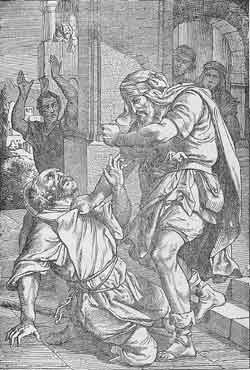 GOSPEL (Hall.
XVill. 23-35.) At that
time, Jesus
spoke to his disciples this parable: The kingdom of heaven
is likened to a king, who would take an account of his servants.
And when he had begun to take the account one was brought to him
that owed him ten thousand talents. And as he had not wherewith
to pay it, his lord commanded that he should be sold, and his wife
and children, and all that he had, and payment to be made. But that
servant falling down, besought him, saying: Have patience with me,
and I will pay thee all. And the lord of that servant, being moved
with pity, let him go, and forgave him the debt. But when
that servant was gone out, he found one of his fellow-servants that
owed him a hundred pence: and laying hold of him, he throttled him,
saying: Pay what thou owest. And his fellow-servant falling down
besought him, saying: Have patience with me, and I will pay thee
all. And he would not; but went and cast him into prison till he
paid the debt. Now his fellow-servants, seeing what was done, were
very much grieved: and they came and told their lord all that was
done. Then his lord called him, and said to him: Thou wicked servant,
I forgave thee all the debt, because thou besoughtest me: shouldst
not thou then have had compassion also on thy fellowservant, even
as I had compassion on thee? And his lord being angry, delivered
him to the torturers until he paid all the debt. So also shall my
heavenly Father do to you, if you forgive not every one his brother
from your hearts.
GOSPEL (Hall.
XVill. 23-35.) At that
time, Jesus
spoke to his disciples this parable: The kingdom of heaven
is likened to a king, who would take an account of his servants.
And when he had begun to take the account one was brought to him
that owed him ten thousand talents. And as he had not wherewith
to pay it, his lord commanded that he should be sold, and his wife
and children, and all that he had, and payment to be made. But that
servant falling down, besought him, saying: Have patience with me,
and I will pay thee all. And the lord of that servant, being moved
with pity, let him go, and forgave him the debt. But when
that servant was gone out, he found one of his fellow-servants that
owed him a hundred pence: and laying hold of him, he throttled him,
saying: Pay what thou owest. And his fellow-servant falling down
besought him, saying: Have patience with me, and I will pay thee
all. And he would not; but went and cast him into prison till he
paid the debt. Now his fellow-servants, seeing what was done, were
very much grieved: and they came and told their lord all that was
done. Then his lord called him, and said to him: Thou wicked servant,
I forgave thee all the debt, because thou besoughtest me: shouldst
not thou then have had compassion also on thy fellowservant, even
as I had compassion on thee? And his lord being angry, delivered
him to the torturers until he paid all the debt. So also shall my
heavenly Father do to you, if you forgive not every one his brother
from your hearts.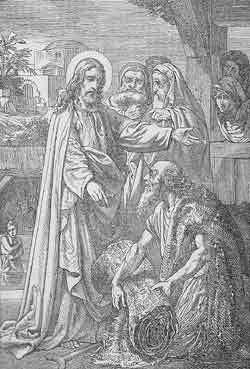 Have
patience with me. (Matt. xviii. z6.)
Have
patience with me. (Matt. xviii. z6.)